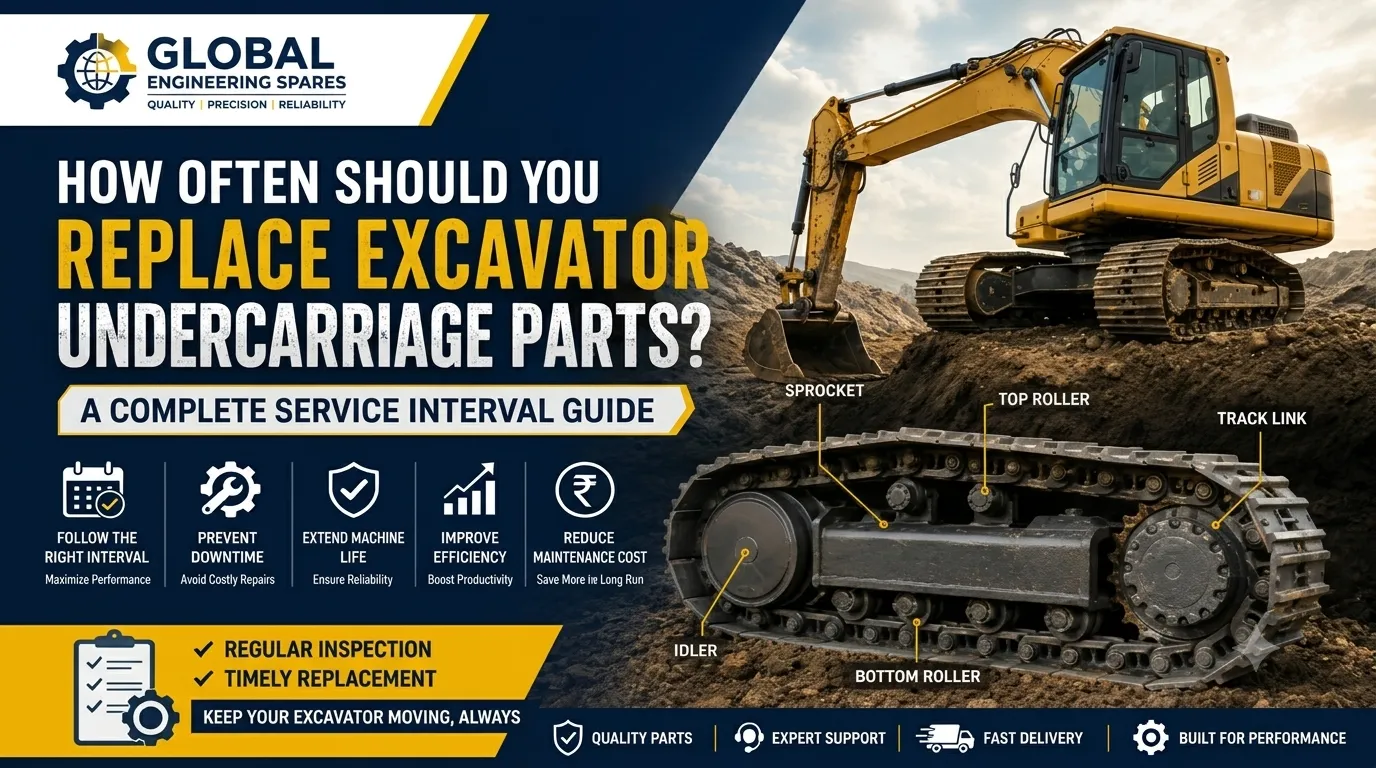
How Often Should You Replace Excavator Undercarriage Parts? A Complete Service Interval Guide
Typical Service Life of Each Undercarriage Component
The figures below are typical ranges under average working conditions. Treat them as planning numbers, not guarantees. Your OEM service manual sets the actual wear limits for your model.
| Component | Typical life (operating hours) | Main reason it gets replaced |
|---|---|---|
| Track roller (bottom roller) | 3,000 – 6,000 | Seal failure, shell wear, flat spots |
| Carrier roller (top roller) | 3,000 – 6,000 | Seal leak, seized shell |
| Idler (front guide wheel) | 4,000 – 8,000 | Running surface wear, flange wear, cracks |
| Sprocket (drive wheel) | 3,000 – 6,000 | Tooth wear, hooked tooth profile |
| Track chain (links, pins, bushings) | 3,000 – 5,000 | Pitch elongation, bushing wear |
| Track plates (shoes) | 3,000 – 5,000 | Grouser wear, cracks, loose bolts |
| Bucket bush | 500 – 1,500 | Play at the bucket pin |
Sealed and lubricated track chains often last longer than standard chains in abrasive ground, which is why many fleet owners choose them for high-hour machines.
What Decides Whether You Get the Low End or the High End
Two identical excavators can wear out at very different rates. These factors do most of the work.
-
Ground conditions: This is the biggest single factor. Abrasive material such as granite, sand, crushed rock, and demolition waste grinds down rollers, links, and sprocket teeth. Soft, wet clay is gentler on wear but packs mud into the undercarriage, which causes its own problems. Impact is a separate factor: rocky, uneven ground loads components harder than level soil.
-
Track tension: A chain that is too tight wears pins, bushings, rollers, and sprocket teeth faster. A chain that is too loose can jump, de-track, and hammer the sprocket. Correct tension is the cheapest way to extend undercarriage life.
-
How the machine is operated: Travelling at high speed, working on slopes, making sharp counter-rotation turns, and operating mostly in reverse all wear specific components faster. Operator habits can change undercarriage life by a large margin.
-
Track plate width: Plates wider than the job needs increase leverage and stress on links and rollers. Use the narrowest plate that gives acceptable flotation on your ground.
-
Cleaning and maintenance: Mud, sand, and rock fragments packed between the sprocket, links, and rollers accelerate wear and can damage seals. Regular cleaning, especially during and after monsoon work, pays back quickly.
-
Part quality: The material grade, heat treatment, and seal design of a component decide how long it survives in the same conditions. A cheap part that fails at half the expected hours costs more once you add the labor, downtime, and collateral wear on neighboring parts.
Component-by-Component Guide
Track Rollers (Bottom Rollers)
Track rollers carry the machine's full weight, so they usually wear out first.
Replace when you see:
- Oil leaking from the end faces (the seal has failed)
- Flat spots or deep grooves on the shell
- Wobble or lateral movement while rotating
- A seized roller that does not turn by hand
- Cracks or chips on the shell or flanges
Practical tip: If several rollers show similar wear, replace the full set rather than one at a time. Mixing new and worn rollers leaves the chain riding unevenly.
Carrier Roller (Top Rollers)
Carrier rollers carry far less load, only the weight of the returning upper track chain, so they often outlast bottom rollers. Machines that travel long distances or work on slopes wear them faster.
Replace when you see:
- Oil leaking from the roller ends
- Squealing or grinding from the upper track
- Visible track sag on the upper run
- A shell that no longer rotates freely
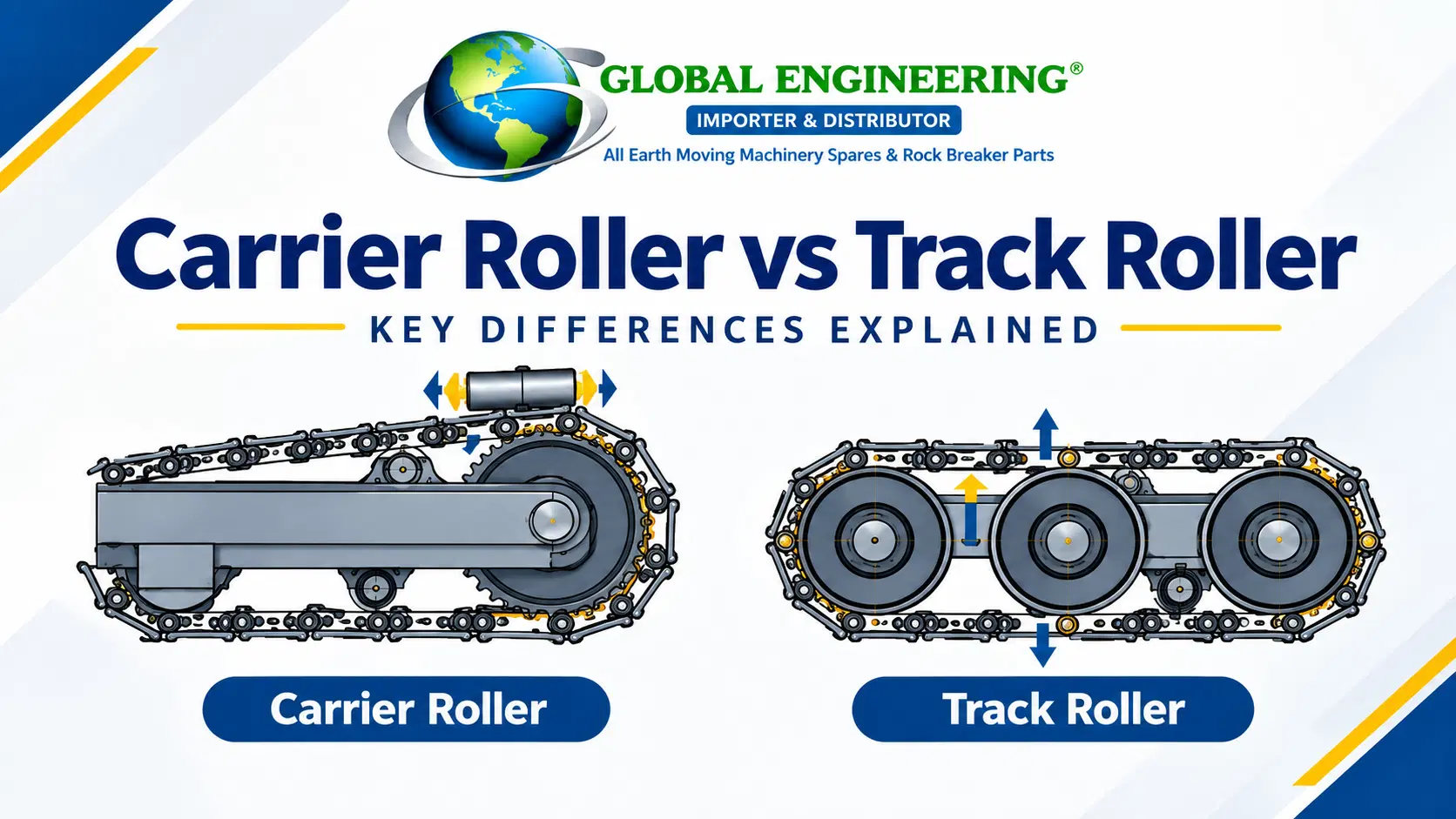
If you are unsure how the two roller types differ, read our guide: Carrier Roller vs Track Roller: Key Differences Explained.
Idler (Front Guide Wheel)
The idler guides the chain and takes impact from the front of the undercarriage. It generally lasts longer than rollers, but a worn idler causes the chain to run off-center.
Replace when you see:
- Cracks anywhere on the shell
- Flat spots or deep grooves on the running surface
- Worn or broken flanges, with the chain wandering or de-tracking
- Lateral wobble or a seized bearing
- Uneven wear on the front chain links
Also check the recoil spring and tensioner at the same time. A tired recoil spring cannot absorb shock, which shortens idler life.
Sprocket (Drive Wheel)
Sprocket teeth wear every time they engage a chain bushing. Once the tooth profile turns hooked or pointed, it hammers the chain instead of rolling through it.
Replace when you see:
- Hooked, pointed, or thin teeth
- Chain skipping under load
- Cracked or chipped teeth
- A recently fitted chain wearing unusually fast
Golden rule: Inspect the sprocket every time you replace the chain. Fitting a new chain onto a worn sprocket damages the new chain quickly. On many machines it is more economical to replace the sprocket (or its segments) and chain together.
Track Chain (Links, Pins, and Bushings)
Track chain wear happens inside the joints. Pins and bushings wear as the chain bends around the sprocket and idler, which stretches the chain's pitch. This is called chain elongation.
How to check: Measure across a set number of links and compare against the OEM's new dimension and wear limit. When elongation reaches the limit in your manual, the chain no longer fits the sprocket properly and should be replaced.
Also replace when you see:
- Cracked or fractured links
- Seized joints that do not flex
- Oil leaks from sealed (S&L) joints
- Rail surfaces worn through
Track Plates (Shoes)
Plates wear on the grouser bars first, then thin out across the body.
Replace when you see:
- Grouser height worn well down, with traction noticeably reduced
- Cracked, bent, or broken plates
- Loose or missing bolts that keep working free
- Plate body worn thin on rocky ground
Replacing plates before they wear through protects the links they bolt to. Retighten plate bolts to specification during routine checks.
Bucket Bushes
Bucket bushes are not part of the track undercarriage, but they are the shortest-interval wear item on the machine and are often replaced in the same service slot.
Replace when you see:
- Play or wobble at the bucket pin
- A knocking sound from the linkage
- Reduced curl or breakout force
- Fine metal dust around the pinhead
In abrasive quarry work, bush life can be at the low end of the range or shorter. Replace them promptly to protect the pin and the dipper arm bore.
A Simple Inspection Schedule
Hours are the trigger for inspection, but condition is the trigger for replacement.
| Interval | What to check |
|---|---|
| Every shift (walk-around) | Oil leaks at rollers and idlers, loose or missing bolts, mud and debris packed in the undercarriage, obvious damage |
| Every 250 hours | Track tension, roller and idler condition, plate bolt torque, grease on bucket pins |
| Every 500 hours | Roller seals, idler flanges, sprocket tooth profile, visual chain wear |
| Every 1,000 hours | Measure chain elongation, grouser height, and bushing wear; plan replacements ahead. |
| Every 2,000 hours | Full undercarriage measurement against OEM wear charts and a replacement forecast |
Write down your measurements each time. A trend line tells you when a component will reach its limit, so you can order parts in advance instead of waiting for a breakdown.
Replace Parts Together or One at a Time?
Undercarriage parts wear as a system. A worn part damages the one next to it.
Replace together:
- Chain and sprocket. A worn sprocket ruins a new chain.
- All rollers on one side when they show similar wear.
- Idler and recoil assembly if the idler is worn from impact damage.
Replace individually:
- A single roller that failed from a seal fault or impact, while the rest are healthy.
- A cracked plate or damaged individual link section.
- Bucket bushes, which wear on their own schedule.
Plan a full rebuild when the chain, sprocket, and rollers are all near their limits at the same time. One planned stoppage with a complete kit is usually cheaper than several emergency repairs spread over a year.
The Cost of Waiting Too Long
Running worn undercarriage parts rarely saves money. The damage moves from part to part:
- A leaking roller seizes and wears a groove into the chain rails.
- A worn sprocket accelerates wear on a new chain.
- A cracked idler can lead to a de-tracked machine and chain damage.
- A loose bucket bush wears the dipper arm bore, turning a small part into a major repair.
Replacing a component at its wear limit costs far less than replacing the three neighboring parts it would have damaged.
Popular Posts